
There is no doubt that we are currently experiencing significant market volatility, and I would like to share with you the below article I have prepared on investor emotions. It serves as a timely reminder of the importance of managing our emotions during these times.

What to do when market volatility triggers an emotional response
The current market volatility may have you feeling many emotions – you may be a little nervous, fearful, or panicked – or you may be completely at ease with the volatility. The good news is that emotional reactions to market events are perfectly normal. And while we may not be able to control the emotions that arise, it’s how we react to these emotions that really matters most.
The cycle of investor emotions
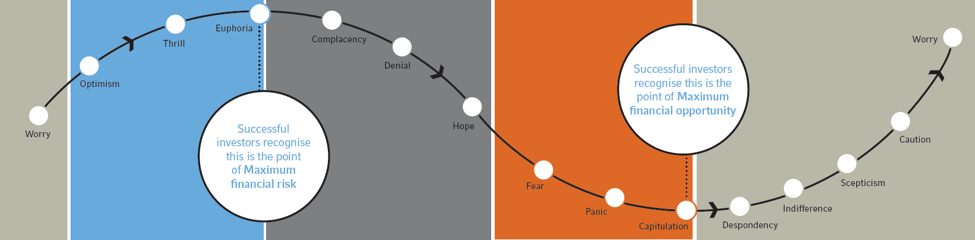
The well-documented “cycle of investor emotions” is based on the principles of behavioural finance. It demonstrates the interplay between the ups and downs of the markets, and the emotions experienced through each phase, such as optimism, euphoria, panic, and despondency. It also highlights the key emotional points where poor decisions are likely to be made.
CYCLE OF INVESTOR EMOTIONS
Source: Russell Investments
(You can also find an interactive overview of the cycle of investor emotions on the Russell Investments website.)
What is of particular interest is that, just as fear and panic during a downturn can lead to reactive, emotional investment decisions, so too can overconfidence during market booms. It seems the market movement and volatility isn’t necessarily the problem – it’s the accompanying emotions and reactions that actually can lead to poor investment decisions and outcomes.
The impact of investing with our emotions
Research shows that when emotions have overruled our fundamental investment principles, the outcome has been less than ideal. In fact, a 2018 study published in the Journal of Financial Planning* found investor panic resulted in a loss of between 8 percent and 15 percent of assets over a 10-year period.
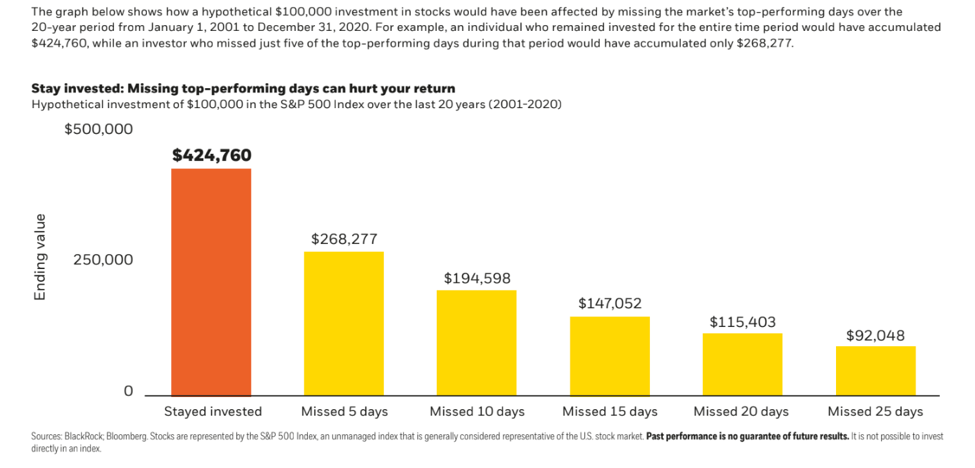
Many will also remember the Global Financial Crisis (GFC) and the outcomes of those who panicked and sold out, versus those who remained in the market and reaped the benefits as the markets regained momentum.
The graph below provides an example of this in practice, showing how a hypothetical investment of $100,000 would have been affected by missing the market’s top-performing days over a 20-year period:
What you might be experiencing now
The last 2-3 years have thrown plenty of unexpected events into the market place – COVID, geopolitical instability, trade tensions, the war in Ukraine, and now the recent inflationary pressure and interest rate increases have triggered a fresh wave of volatility and uncertainty. The financial markets have been working overtime, and the extensive media coverage ensures that virtually no one escapes the messages of fear and panic as the share markets dive. It can be hard not to get swept up in the emotions and wonder, have I got it right? Should I be making a change? This is where we need to revisit our investment fundamentals and put our emotions aside.
Managing emotions
While we can’t control what emotions we feel, we can control how we respond to those emotions. Avoiding the media hype can help, but also reflecting on the following investment fundamentals can provide reassurance:
- Time in the market is more important than timing the market
- Sharp rises and sudden declines are part of the investment journey, and are taken into consideration when designing your investment strategy.
- When the market dives, it’s not the first time, and it won’t be the last time.
- Remember your long term investment strategy.
Ultimately managing emotion is vital to creating wealth over time so if you are feeling uncomfortable or have any questions, please contact the team at McGarrity Wealth Management.